• Subscribe Now
  • Today In History
  • Wars & Events
    • The Russia–Ukraine War
    • American Revolution
    • The Civil War
    • World War I
    • World War II
    • Cold War
    • Korean War
    • Vietnam War
    • Global War on Terror
    • Movements
      • Women’s Rights
      • Civil Rights
      • Abolition of Slavery
  • Famous People
    • U.S. Presidents
    • World Leaders
    • Military Leaders
    • Outlaws & Lawmen
    • Activists
    • Artists & Writers
    • Celebrities
    • Scientists
    • Philosophers
  • Eras
    • Modern Era
      • 2000s
      • 1900s
      • 1800s
    • Early Modern
      • 1700s
      • 1600s
      • 1500s
    • The Middle Ages
    • Classical Era
    • Prehistory
  • Topics
    • Black History
    • Slavery
    • Women’s History
    • Prisoners of War
    • Firsthand Accounts
    • Technology & Weaponry
    • Aviation & Spaceflight
    • Naval & Maritime
    • Politics
    • Military History
    • Art & Literature
    • News
    • Entertainment & Culture
    • Historical Figures
    • Photography
    • Wild West
    • Social History
    • Native American History
  • Magazines
    • American History
    • America’s Civil War
    • Aviation History
    • Civil War Times
    • Military History
    • Military History Quarterly
    • Vietnam
    • Wild West
    • World War II
  • Newsletters
  • Podcasts
  • Privacy Policy
  • Terms of Service
  • Facebook
  • Twitter
  • Instagram
  • YouTube
Skip to content
  • Privacy Policy
  • Terms of Service
  • Facebook
  • Twitter
  • Instagram
  • YouTube
HistoryNet

HistoryNet

The most comprehensive and authoritative history site on the Internet.

  • Subscribe Now
  • Today In History
  • Wars & Events
    • The Russia–Ukraine War
    • American Revolution
    • The Civil War
    • World War I
    • World War II
    • Cold War
    • Korean War
    • Vietnam War
    • Global War on Terror
    • Movements
      • Women’s Rights
      • Civil Rights
      • Abolition of Slavery
  • Famous People
    • U.S. Presidents
    • World Leaders
    • Military Leaders
    • Outlaws & Lawmen
    • Activists
    • Artists & Writers
    • Celebrities
    • Scientists
    • Philosophers
  • Eras
    • Modern Era
      • 2000s
      • 1900s
      • 1800s
    • Early Modern
      • 1700s
      • 1600s
      • 1500s
    • The Middle Ages
    • Classical Era
    • Prehistory
  • Topics
    • Black History
    • Slavery
    • Women’s History
    • Prisoners of War
    • Firsthand Accounts
    • Technology & Weaponry
    • Aviation & Spaceflight
    • Naval & Maritime
    • Politics
    • Military History
    • Art & Literature
    • News
    • Entertainment & Culture
    • Historical Figures
    • Photography
    • Wild West
    • Social History
    • Native American History
  • Magazines
    • American History
    • America’s Civil War
    • Aviation History
    • Civil War Times
    • Military History
    • Military History Quarterly
    • Vietnam
    • Wild West
    • World War II
  • Newsletters
  • Podcasts
Posted inStories

The Secret and Controversial Attempt to Teach German POWs About Freedom

During the summer of 1944, the government launched a secret and ambitious effort to influence the nearly 380,000 Germans imprisoned in the United States.
by Ronald H. Bailey9/11/20087/13/2022
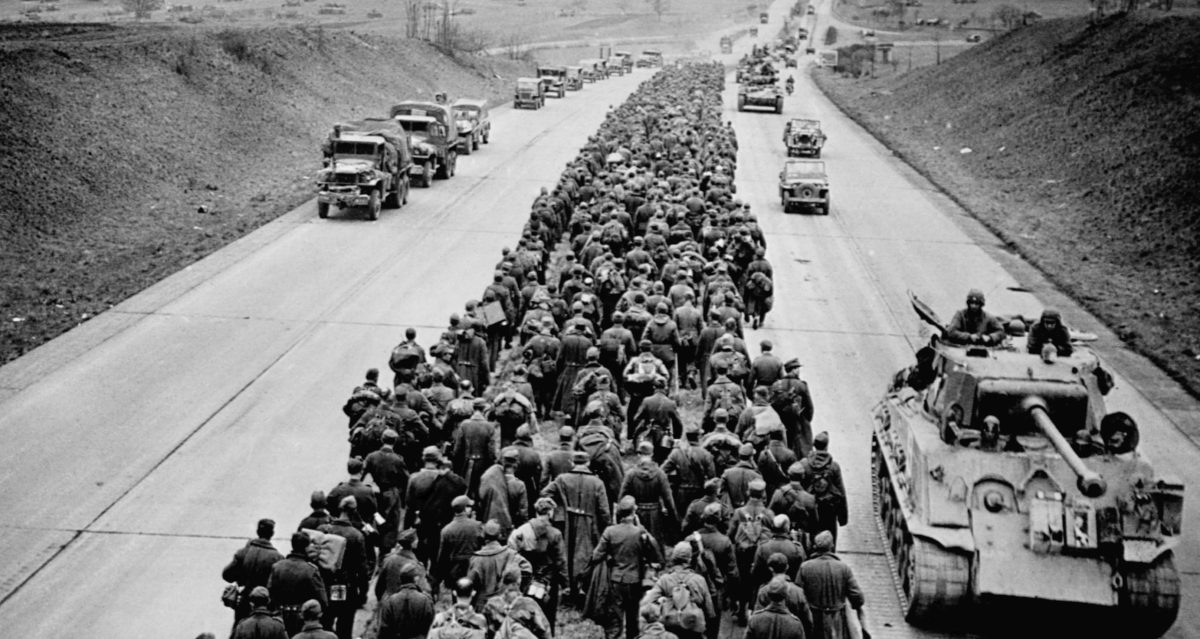
4 May 1945: Germany, Thousands of German prisoners march along a modern German superhighway while their allied captors travel in tanks, trucks, and jeeps. (CORBIS)
Share This Article

Their eight-week curriculum included English, military government, and American and German history. Instruction in military government suffered from a lack of up-to-date information; the U.S. Army in occupied Germany was just now learning on the job. Learning colloquial English was vital to preparing the POWs to serve in the military government. Students varied greatly in their ability to speak English, and they were placed on five different levels of instruction. Everything at Getty was taught in English except German history, which emphasized positive democratic aspects of that nation’s past.

One of the students, Lt. Wolf Dieter Zander, said later that he and his comrades expected stiff, impersonal military instructors. Instead, they were stunned to see that they were being taught by lively academics from Harvard, Brown, and other first-rate universities. A casual air of camaraderie like that at the nearby Factory permeated Fort Getty. Every afternoon, students and professors got together and talked about the ideas presented in the morning lectures. Zander remembered with particular fondness Henry Ehrmann, a German Jewish refugee who had become a professor at the New School for Social Research in New York City. Ehrmann, in describing democratic strands in German history, treated the prisoners with the respect never afforded him in his homeland. Zander exchanged correspondence with him for years after the war.

As it turned out, only a handful of the 528 Getty graduates eventually found jobs in the military government, due to bureaucratic red tape after repatriation. But important things had happened at Getty. A noted New York psychiatrist, Dr. Richard M. Brickner, visited there to evaluate Nazi attitudes among some of the students. Brickner had written the book Is Germany Incurable? and believed that Germans could not be de-Nazified. Brickner reported his pleasant surprise after interviewing five of the prisoners. One interviewee in particular, Brickner wrote, “gave me the first inkling I have had that even downright, regular, typical Germans can be impressed” by such training in democracy.

At the police training school at nearby Fort Wetherill, the eight-week course focused heavily on how law enforcement operates in a democratic society. The curriculum from Getty was condensed, and about half the time devoted to criminal investigation, fingerprinting, crowd control, and other aspects of police work. Perhaps because the students lacked the impressive educational backgrounds of the Getty elite, strong rapport with the faculty never took root. But to get in, students had to endure an even tougher screening process, limiting the number of graduates to a little more than five hundred. Police experts from Chicago and several other major cities were brought in to administer lie detector tests. A number of candidates were rejected because they failed the polygraph on their Nazi backgrounds or leanings toward communism.

Graduates from Wetherill and Getty, along with those from the experimental school at Kearney, were almost immediately repatriated to Germany. That allowed them to bypass the detour scheduled for most German POWs before they could return home—reconstruction duty in labor battalions in France. Colonel Davison and his staff scrambled to come up with a scheme for avoiding that detour. They wanted one more school for exposing prisoners to democracy, thus enabling them to go directly back to Germany, where they might help in the American occupation. “The ultimate mission,” Davison wrote later, “was to return these prisoners to their war-torn homeland as a spearhead of democracy.”

Davison’s solution was an ambitious crash course in democracy. Sited at Fort Eustis, Virginia, a large army base that could accommodate thousands of students, it attempted to shoehorn into only six days the eight-week course in administration conducted at Fort Getty. Lists of candidates submitted by POW camps were screened at the Factory and reduced to more than twenty-five thousand names. The demand to attend was strong because many POWs realized it was the quickest way home. The high standards set at the Getty school were relaxed; most of the students were enlisted men from blue-collar backgrounds. It was enough, a memo stated, to be “cooperative prisoners favorably inclined toward democracy…who had proved their sincerity by attitudes and actions while confined in this country.”

When the first cycle of two thousand POWs began on January 4, 1946, Fort Eustis became a marvel of logistics. In addition to the men hurrying through what they dubbed “the six-day bicycle race,” thousands of others arrived ahead of time—at one point eight thousand prisoners were living there at once—and had to be occupied with films, sports, instruction in English, and other diversions while waiting for their regular schooling. A staff of personal counselors was on hand to help them with problems such as the whereabouts of their families in occupied Germany.

[continued on next page]
Pages: 1 2 3 4 5 6 7
Share This Article
by Ronald H. Bailey

more by Ronald H. Bailey

    Dive deeper

    • Nazis
    • Prisoners of war (POWs)
    • Psychology

    Citation information

    Ronald H. Bailey (2/25/2026) The Secret and Controversial Attempt to Teach German POWs About Freedom. HistoryNet Retrieved from https://historynet.com/the-secret-and-controversial-attempt-to-teach-german-pows-about-freedom/.
    "The Secret and Controversial Attempt to Teach German POWs About Freedom."Ronald H. Bailey - 2/25/2026, https://historynet.com/the-secret-and-controversial-attempt-to-teach-german-pows-about-freedom/
    Ronald H. Bailey 9/11/2008 The Secret and Controversial Attempt to Teach German POWs About Freedom., viewed 2/25/2026,<https://historynet.com/the-secret-and-controversial-attempt-to-teach-german-pows-about-freedom/>
    Ronald H. Bailey - The Secret and Controversial Attempt to Teach German POWs About Freedom. [Internet]. [Accessed 2/25/2026]. Available from: https://historynet.com/the-secret-and-controversial-attempt-to-teach-german-pows-about-freedom/
    Ronald H. Bailey. "The Secret and Controversial Attempt to Teach German POWs About Freedom." Ronald H. Bailey - Accessed 2/25/2026. https://historynet.com/the-secret-and-controversial-attempt-to-teach-german-pows-about-freedom/
    "The Secret and Controversial Attempt to Teach German POWs About Freedom." Ronald H. Bailey [Online]. Available: https://historynet.com/the-secret-and-controversial-attempt-to-teach-german-pows-about-freedom/. [Accessed: 2/25/2026]

    Related stories

    Stories

    Celebrating the Legacy of the Office of Strategic Services 82 Years On

    From the OSS to the CIA, how Wild Bill Donovan shaped the American intelligence community.

    ww2-homefront-poster-war-bond
    Portfolio

    During the War Years, Posters From the American Homefront Told You What to Do — And What Not to Do

    If you needed some motivation during the war years, there was probably a poster for that.

    ww2-termoli-italy-pow-boat
    Feature

    An SAS Rescue Mission Mission Gone Wrong

    When covert operatives went into Italy to retrieve prisoners of war, little went according to plan.

    ww2-505-parachute-infantry
    Feature

    Could These American Paratroopers Stop the Germans from Reaching Utah Beach on D-Day?

    The peaceful French countryside around La Fiere Bridge erupted into a desperate firefight on June 6, 1944.

    HistoryNet
    • Facebook
    • Twitter
    • Instagram
    • YouTube

    “History is a guide to navigation in perilous times. History is who we are and why we are the way we are.”

    David McCullough, author of “1776”

    HistoryNet.com is brought to you by HistoryNet LLC, the world’s largest publisher of history magazines. HistoryNet.com contains daily features, photo galleries and over 25,000 articles originally published in our nine magazines.

    Our Magazines

    • American History
    • America’s Civil War
    • Aviation History
    • Civil War Times
    • Military History
    • Military History Quarterly
    • Vietnam
    • Wild West
    • World War II

    About Us

    • What Is HistoryNet.com?
    • Advertise With Us
    • Careers
    • Meet Our Staff!

    Stay Curious

    Subscribe to receive our weekly newsletter with top stories from master historians.

    sign me up!

    © 2026 HistoryNet.
    • Privacy Policy
    • Terms of Service