• Subscribe Now
  • Today In History
  • Wars & Events
    • The Russia–Ukraine War
    • American Revolution
    • The Civil War
    • World War I
    • World War II
    • Cold War
    • Korean War
    • Vietnam War
    • Global War on Terror
    • Movements
      • Women’s Rights
      • Civil Rights
      • Abolition of Slavery
  • Famous People
    • U.S. Presidents
    • World Leaders
    • Military Leaders
    • Outlaws & Lawmen
    • Activists
    • Artists & Writers
    • Celebrities
    • Scientists
    • Philosophers
  • Eras
    • Modern Era
      • 2000s
      • 1900s
      • 1800s
    • Early Modern
      • 1700s
      • 1600s
      • 1500s
    • The Middle Ages
    • Classical Era
    • Prehistory
  • Topics
    • Black History
    • Slavery
    • Women’s History
    • Prisoners of War
    • Firsthand Accounts
    • Technology & Weaponry
    • Aviation & Spaceflight
    • Naval & Maritime
    • Politics
    • Military History
    • Art & Literature
    • News
    • Entertainment & Culture
    • Historical Figures
    • Photography
    • Wild West
    • Social History
    • Native American History
  • Magazines
    • American History
    • America’s Civil War
    • Aviation History
    • Civil War Times
    • Military History
    • Military History Quarterly
    • Vietnam
    • Wild West
    • World War II
  • Newsletters
  • Podcasts
  • Privacy Policy
  • Terms of Service
  • Facebook
  • Twitter
  • Instagram
  • YouTube
Skip to content
  • Privacy Policy
  • Terms of Service
  • Facebook
  • Twitter
  • Instagram
  • YouTube
HistoryNet

HistoryNet

The most comprehensive and authoritative history site on the Internet.

  • Subscribe Now
  • Today In History
  • Wars & Events
    • The Russia–Ukraine War
    • American Revolution
    • The Civil War
    • World War I
    • World War II
    • Cold War
    • Korean War
    • Vietnam War
    • Global War on Terror
    • Movements
      • Women’s Rights
      • Civil Rights
      • Abolition of Slavery
  • Famous People
    • U.S. Presidents
    • World Leaders
    • Military Leaders
    • Outlaws & Lawmen
    • Activists
    • Artists & Writers
    • Celebrities
    • Scientists
    • Philosophers
  • Eras
    • Modern Era
      • 2000s
      • 1900s
      • 1800s
    • Early Modern
      • 1700s
      • 1600s
      • 1500s
    • The Middle Ages
    • Classical Era
    • Prehistory
  • Topics
    • Black History
    • Slavery
    • Women’s History
    • Prisoners of War
    • Firsthand Accounts
    • Technology & Weaponry
    • Aviation & Spaceflight
    • Naval & Maritime
    • Politics
    • Military History
    • Art & Literature
    • News
    • Entertainment & Culture
    • Historical Figures
    • Photography
    • Wild West
    • Social History
    • Native American History
  • Magazines
    • American History
    • America’s Civil War
    • Aviation History
    • Civil War Times
    • Military History
    • Military History Quarterly
    • Vietnam
    • Wild West
    • World War II
  • Newsletters
  • Podcasts
Posted inStories

The Secret and Controversial Attempt to Teach German POWs About Freedom

During the summer of 1944, the government launched a secret and ambitious effort to influence the nearly 380,000 Germans imprisoned in the United States.
by Ronald H. Bailey9/11/20087/13/2022
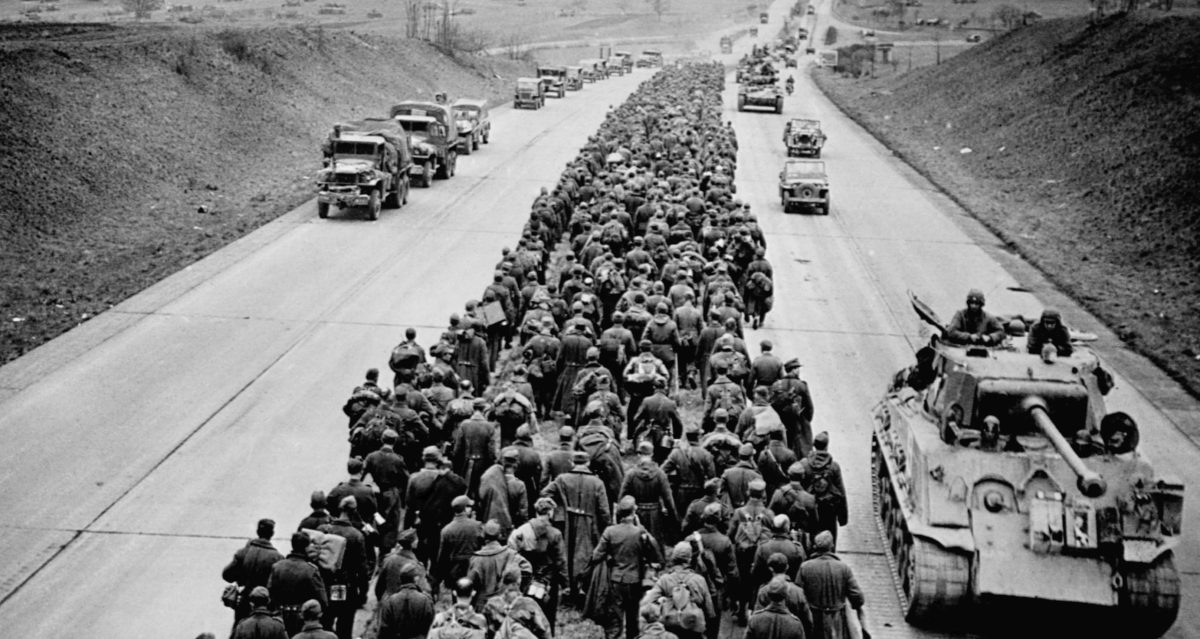
4 May 1945: Germany, Thousands of German prisoners march along a modern German superhighway while their allied captors travel in tanks, trucks, and jeeps. (CORBIS)
Share This Article

Though the films were in English, the Factory prepared German synopses describing the plots and highlighting the educational points to be made. The box office boomed. Prisoners who earned an average of forty cents a day proved willing to spend fifteen cents of it for cinematic diversion. By the end of September 1945, four months after the Factory’s movie program began, every German prisoner in the United States had viewed an average of ten feature films. Healthy box office receipts, together with proceeds from Der Ruf, helped bolster the claim that the reeducation program was paying for itself.

Attendance at some showings was mandatory. These required films were documentaries of the horrors of the Nazi death camps at Dachau and Auschwitz; the inmates at some camps referred to them as Knochhenfilmen, or “bone films.” One German prisoner, Gerhard Hennes, remembered how the audience “stared in silence, struggling but unable to believe what we Germans had done to Jews, gypsies, prisoners of war and many others deemed inferior or expendable.”

The atrocity films provoked stunningly dramatic reactions—or merely disbelief. At Eglin Field, Florida, POWs took up a collection and contributed $2,371 to American war charities. At Camp Butner, one thousand prisoners were so ashamed that they burned their German uniforms. All the same, a later survey of twenty thousand prisoners about to be repatriated indicated that nearly two-thirds simply refused to believe Ger-many had committed these atrocities.

As the war in Europe wound down, the reeducation program continued to operate covertly. Any lapses in secrecy were quickly covered up. In February 1945, after a camp official slipped up in a Kiwanis Club speech, Texas’s Waco News-Tribune headlined its story, “Course in American Life Taught POWs.” Wire services failed to pick up the story, which the army immediately dismissed as “fanciful.”

The secrecy lid was still so tight that a couple of months later, Rep. Richard F. Harless of Arizona inspected his state’s camp at Papago Park and came away clueless about what he had seen. In Congress, citing a Soviet scheme for indoctrinating German POWs as Communists, he denounced the apparent fact that “the United States has not done a single thing to educate German prisoners in the American way of life.”

Then, on May 28, 1945, less than three weeks after Germany’s unconditional surrender, the War Department revealed the existence of the program. Not many in the press, even those who had been harping about failures in the prison camps, paid much attention to the news. Meanwhile, the reeducation program continued because it would be many months before German POWs went home.

If the end of the war in Europe ended the need for secrecy, it had other ramifications for the reeducation program. Canteen privileges in the camps were cut back and the quantity and quality of the daily diet reduced. POWs perceived the changes as a form of reprisal now that the United States did not have to worry about its own prisoners in Germany, and enthusiasm for reeducation tended to wane.

In addition, an intensification of concern within the War Department about the alleged threat of domestic communism undermined morale in the Special Projects Division. Undocumented accusations set off a Red scare and a loyalty check of Davison’s headquarters staff. Three staff members accused of leaning to the left were transferred out. The climate of fear grew so intense during the late summer of 1945 that the former Harvard dean Howard Mumford Jones abruptly resigned his position as a civilian adviser.

At the same time, the reeducation program now had to cope with the need for trained and trustworthy German POWs to help staff the American zone of occupation in their newly conquered homeland. Special Projects men and a dozen of the most highly regarded POWs at the Factory met and recommended the establishment of schools to prepare prisoners selected from camps all over the United States. The first school—an experimental course in military government administration at Fort Kearney, site of the Factory—operated full-time for eight weeks. In July 1945, it graduated seventy-three POWs who received certificates of achievement for completing this training course “established for the reeducation of selected citizens of Germany.”

The Kearney experiment proved so successful that new schools were created at Fort Getty and Fort Wetherill, nearby coastal artillery installations just across Narraganset Bay. Officials at camps across America recommended nearly eighteen thousand candidates for these two schools—training administrative personnel at Getty and policemen at Wetherill for the military government in Germany. A rigorous screening process finally pared the number to about three thousand seven hundred men. The candidates for the Getty administration school in particular were an elite group: 43 percent were university graduates, 25 percent were businessmen or other white-collar workers, and 10 percent were former civil servants.

[continued on next page]
Pages: 1 2 3 4 5 6 7
Share This Article
by Ronald H. Bailey

more by Ronald H. Bailey

    Dive deeper

    • Nazis
    • Prisoners of war (POWs)
    • Psychology

    Citation information

    Ronald H. Bailey (2/25/2026) The Secret and Controversial Attempt to Teach German POWs About Freedom. HistoryNet Retrieved from https://historynet.com/the-secret-and-controversial-attempt-to-teach-german-pows-about-freedom/.
    "The Secret and Controversial Attempt to Teach German POWs About Freedom."Ronald H. Bailey - 2/25/2026, https://historynet.com/the-secret-and-controversial-attempt-to-teach-german-pows-about-freedom/
    Ronald H. Bailey 9/11/2008 The Secret and Controversial Attempt to Teach German POWs About Freedom., viewed 2/25/2026,<https://historynet.com/the-secret-and-controversial-attempt-to-teach-german-pows-about-freedom/>
    Ronald H. Bailey - The Secret and Controversial Attempt to Teach German POWs About Freedom. [Internet]. [Accessed 2/25/2026]. Available from: https://historynet.com/the-secret-and-controversial-attempt-to-teach-german-pows-about-freedom/
    Ronald H. Bailey. "The Secret and Controversial Attempt to Teach German POWs About Freedom." Ronald H. Bailey - Accessed 2/25/2026. https://historynet.com/the-secret-and-controversial-attempt-to-teach-german-pows-about-freedom/
    "The Secret and Controversial Attempt to Teach German POWs About Freedom." Ronald H. Bailey [Online]. Available: https://historynet.com/the-secret-and-controversial-attempt-to-teach-german-pows-about-freedom/. [Accessed: 2/25/2026]

    Related stories

    Stories

    Celebrating the Legacy of the Office of Strategic Services 82 Years On

    From the OSS to the CIA, how Wild Bill Donovan shaped the American intelligence community.

    ww2-homefront-poster-war-bond
    Portfolio

    During the War Years, Posters From the American Homefront Told You What to Do — And What Not to Do

    If you needed some motivation during the war years, there was probably a poster for that.

    ww2-termoli-italy-pow-boat
    Feature

    An SAS Rescue Mission Mission Gone Wrong

    When covert operatives went into Italy to retrieve prisoners of war, little went according to plan.

    ww2-505-parachute-infantry
    Feature

    Could These American Paratroopers Stop the Germans from Reaching Utah Beach on D-Day?

    The peaceful French countryside around La Fiere Bridge erupted into a desperate firefight on June 6, 1944.

    HistoryNet
    • Facebook
    • Twitter
    • Instagram
    • YouTube

    “History is a guide to navigation in perilous times. History is who we are and why we are the way we are.”

    David McCullough, author of “1776”

    HistoryNet.com is brought to you by HistoryNet LLC, the world’s largest publisher of history magazines. HistoryNet.com contains daily features, photo galleries and over 25,000 articles originally published in our nine magazines.

    Our Magazines

    • American History
    • America’s Civil War
    • Aviation History
    • Civil War Times
    • Military History
    • Military History Quarterly
    • Vietnam
    • Wild West
    • World War II

    About Us

    • What Is HistoryNet.com?
    • Advertise With Us
    • Careers
    • Meet Our Staff!

    Stay Curious

    Subscribe to receive our weekly newsletter with top stories from master historians.

    sign me up!

    © 2026 HistoryNet.
    • Privacy Policy
    • Terms of Service