• Subscribe Now
  • Today In History
  • Wars & Events
    • The Russia–Ukraine War
    • American Revolution
    • The Civil War
    • World War I
    • World War II
    • Cold War
    • Korean War
    • Vietnam War
    • Global War on Terror
    • Movements
      • Women’s Rights
      • Civil Rights
      • Abolition of Slavery
  • Famous People
    • U.S. Presidents
    • World Leaders
    • Military Leaders
    • Outlaws & Lawmen
    • Activists
    • Artists & Writers
    • Celebrities
    • Scientists
    • Philosophers
  • Eras
    • Modern Era
      • 2000s
      • 1900s
      • 1800s
    • Early Modern
      • 1700s
      • 1600s
      • 1500s
    • The Middle Ages
    • Classical Era
    • Prehistory
  • Topics
    • Black History
    • Slavery
    • Women’s History
    • Prisoners of War
    • Firsthand Accounts
    • Technology & Weaponry
    • Aviation & Spaceflight
    • Naval & Maritime
    • Politics
    • Military History
    • Art & Literature
    • News
    • Entertainment & Culture
    • Historical Figures
    • Photography
    • Wild West
    • Social History
    • Native American History
  • Magazines
    • American History
    • America’s Civil War
    • Aviation History
    • Civil War Times
    • Military History
    • Military History Quarterly
    • Vietnam
    • Wild West
    • World War II
  • Newsletters
  • Podcasts
  • Privacy Policy
  • Terms of Service
  • Facebook
  • Twitter
  • Instagram
  • YouTube
Skip to content
  • Privacy Policy
  • Terms of Service
  • Facebook
  • Twitter
  • Instagram
  • YouTube
HistoryNet

HistoryNet

The most comprehensive and authoritative history site on the Internet.

  • Subscribe Now
  • Today In History
  • Wars & Events
    • The Russia–Ukraine War
    • American Revolution
    • The Civil War
    • World War I
    • World War II
    • Cold War
    • Korean War
    • Vietnam War
    • Global War on Terror
    • Movements
      • Women’s Rights
      • Civil Rights
      • Abolition of Slavery
  • Famous People
    • U.S. Presidents
    • World Leaders
    • Military Leaders
    • Outlaws & Lawmen
    • Activists
    • Artists & Writers
    • Celebrities
    • Scientists
    • Philosophers
  • Eras
    • Modern Era
      • 2000s
      • 1900s
      • 1800s
    • Early Modern
      • 1700s
      • 1600s
      • 1500s
    • The Middle Ages
    • Classical Era
    • Prehistory
  • Topics
    • Black History
    • Slavery
    • Women’s History
    • Prisoners of War
    • Firsthand Accounts
    • Technology & Weaponry
    • Aviation & Spaceflight
    • Naval & Maritime
    • Politics
    • Military History
    • Art & Literature
    • News
    • Entertainment & Culture
    • Historical Figures
    • Photography
    • Wild West
    • Social History
    • Native American History
  • Magazines
    • American History
    • America’s Civil War
    • Aviation History
    • Civil War Times
    • Military History
    • Military History Quarterly
    • Vietnam
    • Wild West
    • World War II
  • Newsletters
  • Podcasts
Posted inStories

The Secret and Controversial Attempt to Teach German POWs About Freedom

During the summer of 1944, the government launched a secret and ambitious effort to influence the nearly 380,000 Germans imprisoned in the United States.
by Ronald H. Bailey9/11/20087/13/2022
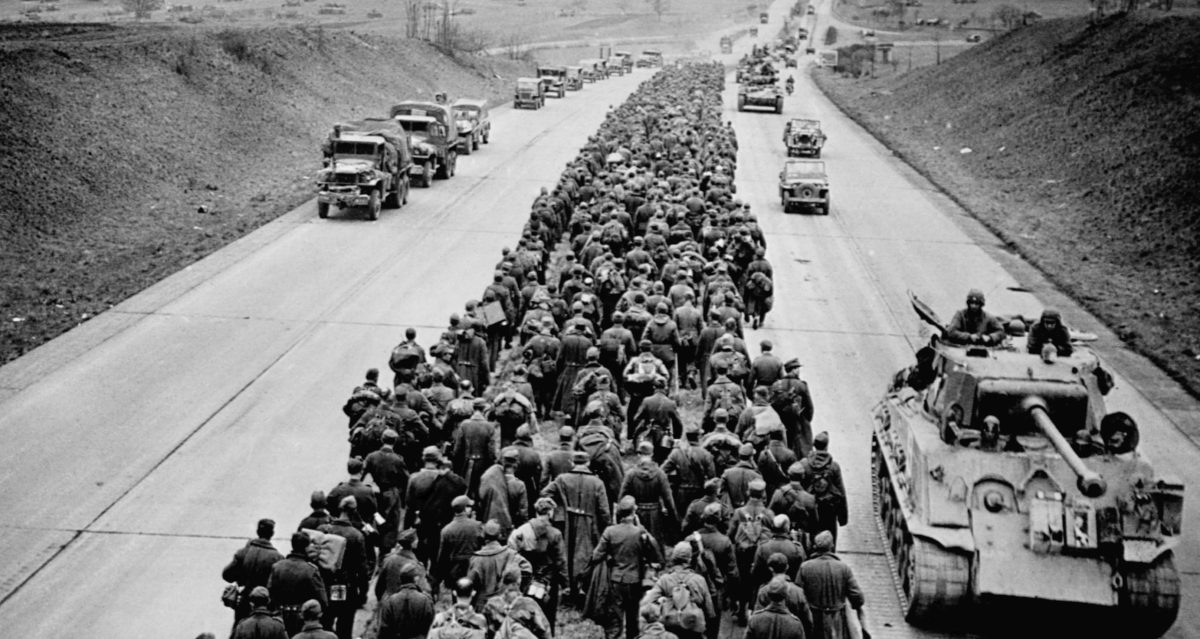
4 May 1945: Germany, Thousands of German prisoners march along a modern German superhighway while their allied captors travel in tanks, trucks, and jeeps. (CORBIS)
Share This Article

Meanwhile, the Factory-produced Der Ruf evidently exerted a benign effect on the newspapers produced by the prisoners in camps across the United States. These papers typically contained eight or ten mimeographed pages and appeared once or twice a month. At the inception of Der Ruf in March 1945, monitors at the Factory kept tabs on the political complexion of camp papers. About half of the fifty papers surveyed were deemed Nazi in editorial policy. Six months later, a Factory survey of eighty camp papers counted only one that was openly Nazi.

This radical change presumably reflected the influence not only of Der Ruf, but of the entire reeducation program—and particularly of the American officers specially assigned to each camp to make it work. These company-grade officers were dubbed Assistant Executive Officers (AEOs) to disguise their role in coordinating reeducation activities. Qualified AEOs were hard to come by. Most German-speaking officers had already been absorbed into military intelligence and other roles, and the Special Projects Division frequently had to dispense with the language requirement. Prospective AEOs got a ten-day orientation at Fort Slocum, New York, in such topics as German history, psychology of prisoners of war, camp educational activities, and film, art, and other media.

Once assigned to camps, the AEOs sometimes encountered commanding officers who opposed reeducation. Several Jewish AEOs reported having more trouble with their fellow officers than with the prisoners. At one camp, an anti-Semitic commander encouraged the Germans and the American enlisted men to ignore the Jewish AEO’s directions, and then had him replaced by a gentile. Camp commanders in general were frequently unsuited to their job, having already been found unsatisfactory for combat. “We were pretty much dredging the bottom of the barrel,” recalled McKnight, who had administered POW activities before becoming the reeducation deputy.

Some commanders contributed to the AEOs’ problems in yet another way. They found it easier to let the POWs rule themselves, allowing Nazi officers to keep their fellow prisoners in line. AEOs had to find inconspicuous means to identify and neutralize Nazis who controlled prisoner newspapers, camp libraries, education courses, and even the selection of films to be shown. Segregating hard-core elements in their own compounds or transferring them to their own camps proved a continuing problem in many places, though Nazi dominance tended to lessen as the war’s tide turned in Europe.

Successful reeducation often depended largely on the energy and imagination of the camp’s AEO. He might be called upon to change the editorial policy of the newspaper, increase church attendance, arrange for a university in the area to conduct extension courses in the camp, establish classroom courses in American history, help organize a drama club, or ferret out questionable books. Pamphlets, books, and calendars arriving from the German Red Cross often contained Nazi propaganda. Gifts sent to the camps via that organization during the 1944 Christmas season included walnuts stuffed with propaganda.

A good AEO learned to work swiftly. Recalcitrant prisoners in one camp targeted a vocal anti-Nazi by putting up posters accusing him of being a traitor. The AEO responded by preparing posters praising him as a man “who lives only for freedom and his fatherland” and posting them overnight.

The AEO at Camp Butner, North Carolina, saw an opportunity to teach a lesson in tolerance. When the POW music program became so popular that there was a shortage of instruments, he brought in a local dealer. “Mr. Goldman is exactly five feet high and exudes a girth any three men would be proud of,” the AEO wrote, “and he is obviously Jewish.” Mr. Goldman supplied all the needed instruments and was paid from the camp’s canteen funds. Every time he showed up at the camp, he was surrounded by friendly and appreciative German prisoners.

AEOs also played a key role in selecting and promoting the showing of films from a list approved by the Factory. Perhaps because of the emphasis on Der Ruf and other literature, the reeducation program lagged in promoting a medium that house intellectuals may have considered lowbrow. Eventually, the Factory approved a list of 115 feature films including Abe Lincoln in Illinois, The Adventures of Tom Sawyer, and other movies that “fostered respect for our democratic institutions.” Their criteria excluded the gangster movies and cowboy films that Nazi prisoners had previously selected to emphasize the shortcomings of American society.

At first Hollywood’s leaders, many of them Jewish, balked at the prospect of supplying films for the program. They were unaware of its purpose and thought the German prisoners were merely being coddled. “Finally,” Major McKnight recalled, “the Secretary of War had to call in all the Warner Brothers people—the key ones—and explain what was being done and that it was a secret program.”

[continued on next page]
Pages: 1 2 3 4 5 6 7
Share This Article
by Ronald H. Bailey

more by Ronald H. Bailey

    Dive deeper

    • Nazis
    • Prisoners of war (POWs)
    • Psychology

    Citation information

    Ronald H. Bailey (2/25/2026) The Secret and Controversial Attempt to Teach German POWs About Freedom. HistoryNet Retrieved from https://historynet.com/the-secret-and-controversial-attempt-to-teach-german-pows-about-freedom/.
    "The Secret and Controversial Attempt to Teach German POWs About Freedom."Ronald H. Bailey - 2/25/2026, https://historynet.com/the-secret-and-controversial-attempt-to-teach-german-pows-about-freedom/
    Ronald H. Bailey 9/11/2008 The Secret and Controversial Attempt to Teach German POWs About Freedom., viewed 2/25/2026,<https://historynet.com/the-secret-and-controversial-attempt-to-teach-german-pows-about-freedom/>
    Ronald H. Bailey - The Secret and Controversial Attempt to Teach German POWs About Freedom. [Internet]. [Accessed 2/25/2026]. Available from: https://historynet.com/the-secret-and-controversial-attempt-to-teach-german-pows-about-freedom/
    Ronald H. Bailey. "The Secret and Controversial Attempt to Teach German POWs About Freedom." Ronald H. Bailey - Accessed 2/25/2026. https://historynet.com/the-secret-and-controversial-attempt-to-teach-german-pows-about-freedom/
    "The Secret and Controversial Attempt to Teach German POWs About Freedom." Ronald H. Bailey [Online]. Available: https://historynet.com/the-secret-and-controversial-attempt-to-teach-german-pows-about-freedom/. [Accessed: 2/25/2026]

    Related stories

    Stories

    Celebrating the Legacy of the Office of Strategic Services 82 Years On

    From the OSS to the CIA, how Wild Bill Donovan shaped the American intelligence community.

    ww2-homefront-poster-war-bond
    Portfolio

    During the War Years, Posters From the American Homefront Told You What to Do — And What Not to Do

    If you needed some motivation during the war years, there was probably a poster for that.

    ww2-termoli-italy-pow-boat
    Feature

    An SAS Rescue Mission Mission Gone Wrong

    When covert operatives went into Italy to retrieve prisoners of war, little went according to plan.

    ww2-505-parachute-infantry
    Feature

    Could These American Paratroopers Stop the Germans from Reaching Utah Beach on D-Day?

    The peaceful French countryside around La Fiere Bridge erupted into a desperate firefight on June 6, 1944.

    HistoryNet
    • Facebook
    • Twitter
    • Instagram
    • YouTube

    “History is a guide to navigation in perilous times. History is who we are and why we are the way we are.”

    David McCullough, author of “1776”

    HistoryNet.com is brought to you by HistoryNet LLC, the world’s largest publisher of history magazines. HistoryNet.com contains daily features, photo galleries and over 25,000 articles originally published in our nine magazines.

    Our Magazines

    • American History
    • America’s Civil War
    • Aviation History
    • Civil War Times
    • Military History
    • Military History Quarterly
    • Vietnam
    • Wild West
    • World War II

    About Us

    • What Is HistoryNet.com?
    • Advertise With Us
    • Careers
    • Meet Our Staff!

    Stay Curious

    Subscribe to receive our weekly newsletter with top stories from master historians.

    sign me up!

    © 2026 HistoryNet.
    • Privacy Policy
    • Terms of Service